
Hardware
Consumer 3D Printing: A Practical Overview
How desktop FDM and MSLA printers work, what to expect from entry-level hardware, and common considerations for first-time buyers.
Read article →An overview of desktop additive manufacturing: how FDM and resin printers work, what materials are available, and where Canadian makers gather to fabricate, share, and iterate.
Featured Articles
Practical coverage of 3D printing hardware, materials science, and the organized community spaces where Canadians prototype and fabricate.
How desktop FDM and MSLA printers work, what to expect from entry-level hardware, and common considerations for first-time buyers.
Read article →
A breakdown of common FDM filament materials, their mechanical properties, print temperature requirements, and typical use cases.
Read article →
An overview of organized maker communities in Canada — from community workshops to university-affiliated fabrication labs open to the public.
Read article →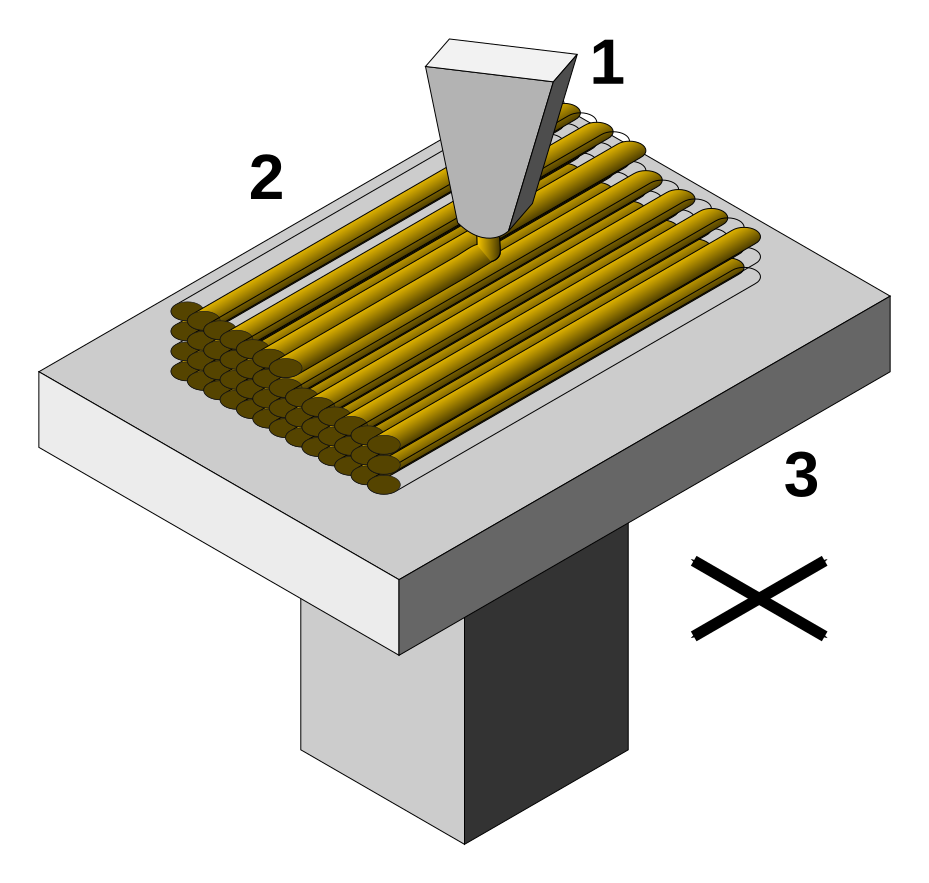
How it works
FDM — sometimes called fused filament fabrication (FFF) — is the most widely used desktop 3D printing process. A thermoplastic filament is fed through a heated nozzle that traces a cross-section of the object on each layer, building the part from the bottom up.
Desktop FDM printers typically use 1.75 mm filament diameter, with nozzle diameters ranging from 0.2 mm to 0.8 mm depending on the resolution and speed requirements.
Read the guide →Key Concepts
FDM, MSLA, DLP — how each technology deposits or cures material, and the practical differences for home use.
PLA, PETG, ABS, ASA, TPU, and specialty materials. Print temperatures, bed adhesion, and post-processing requirements.
How slicer software converts a 3D model into printer instructions. Layer height, infill density, support structures, and print speed trade-offs.
Overhangs, bridging, wall thickness, layer adhesion strength — design principles specific to additive manufacturing.
Organized community spaces in Toronto, Vancouver, Montreal, Calgary, and other Canadian cities with shared 3D printing equipment.
Replacement parts, custom enclosures, tooling jigs, artistic objects — practical examples of what home printers are routinely used for.